

9 Tips for Decluttering Before Moving That Save Time and Money
Last Updated: October 25, 2026
Quick Summary
Decluttering before moving saves time and money by reducing the volume of items to transport and pack. Start at least 8 weeks before your move date, sorting items into Keep, Donate, Sell, and Discard piles, then schedule pickups and disposal before moving day to avoid accidentally packing unwanted items.
- Start decluttering at least 8 weeks before your move date to allow time for sales, donations, and pickups.
- Sort items into four categories: Keep, Donate, Sell, and Discard, working room by room to stay organized.
- List high-value items for sale 7-14 days before your move; items unsold after 10-14 days should be relisted lower or donated.
- Call donation centers in advance to confirm what they accept and book pickups 1-3 weeks out before your move week.
- Schedule hazardous waste drop-off and junk removal appointments early; many communities have limited collection windows or require appointments.
Table of Contents
- Why Decluttering Before Moving Matters
- Create a Moving Decluttering Timeline That Works
- Build Your Decluttering Checklist Before Moving
- Work Room by Room to Stay Organized
- Decide What to Get Rid of Before Moving
- How to Decide What to Keep When Moving
- Handle Donation, Resale, and Disposal of Unwanted Items
- Schedule Your Professional Junk Removal Service
- Frequently Asked Questions
Why Decluttering Before Moving Matters
Decluttering before moving makes the process faster, cheaper, and less stressful, fewer boxes mean lower moving costs and faster setup.
Homeowners underestimate how much stuff accumulates; a basement, attic, or spare bedroom can hold years of forgotten items that consume moving resources and often end up unpacked anyway.
Starting early with decluttering before moving gives you time to donate, sell valuable pieces, or arrange proper disposal for hazardous materials.
Create a Moving Decluttering Timeline That Works
A solid decluttering timeline prevents last-minute stress. Start at least 8 weeks before your move date to sort, donate, sell, schedule pickups, and arrange removal of larger items.
The schedule below assumes an 8-week runway. With less time, compress early planning weeks and prioritize the highest-volume spaces.
Week 1: Assess and set up
- Walk through every room with a notepad and note the three areas with the most accumulated items (typically garage, basement, and closets).
- Set up a staging area, a garage bay, spare room, or covered porch, with four labeled zones: Keep, Donate, Sell, Discard.
- Gather supplies: boxes, heavy-duty bags, markers, tape, and a scale if you plan to sell items online.
Week 2: Infrequently used spaces
- Start in the garage, attic, or basement, these areas usually hold the most forgotten items and the least emotional attachment.
- Sort one category at a time (tools, holiday decor, sports equipment) rather than one shelf at a time; category sorting produces faster decisions.
- Set a hard rule: anything not used in the past 12 months and not tied to a specific future plan goes into Donate, Sell, or Discard.
Week 3: Sell high-value items first
- List furniture, electronics, tools, and collectibles on marketplaces this week, not later. Most items need 7-14 days of listing time to sell, and you want cash and pickup completed before packing begins.
- Price to sell: check completed listings for comparable items and price at or slightly below the midpoint. Items that sit unsold for two weeks should be relisted lower or moved to Donate.
- Schedule buyer pickups for the same week so sold items leave the house before they get packed by mistake.
Week 4: Donation logistics
- Call donation centers before you load the car. Confirm what they accept, many charities decline mattresses, large appliances, and damaged furniture, and ask about pickup minimums and scheduling windows.
- Many national charities schedule pickups 1-3 weeks out, so book now to secure a date before your move week.
- Get a donation receipt for tax purposes; itemize high-value donations and photograph them before pickup.
Week 5: Living areas
- Tackle bedrooms, bathrooms, and closets. Sort clothing by whether it fits and whether you wore it in the past year.
- Consolidate duplicates: keep the best version of sheets, towels, kitchen tools, and small appliances; move the rest to Donate or Sell.
- Pack the Keep pile for these rooms as you go so completed rooms stay completed.
Week 6: Kitchen and paperwork
- Clear cabinets, pantry, and drawers. Donate unopened nonperishable food to a local food bank; discard expired items.
- Shred sensitive documents you don't need to keep, and scan records you want to retain digitally. This is also the week to cancel or transfer local services and update your address.
- Dispose of medications at a take-back location rather than flushing them; many pharmacies and municipal sites host permanent collection boxes (the FDA).
Week 7: Final sweep and hazardous items
- Handle paint, chemicals, batteries, and electronics through your local household hazardous waste program. These often require an appointment or have limited drop-off days, so confirm the schedule early in the week.
- Schedule bulky-item pickup or a junk removal appointment for the end of this week, after the final sweep but before moving-day packing.
- Do a room-by-room walkthrough with your checklist and confirm every area is marked complete.
Week 8: Disposal completion and packing
- Confirm all donation and junk removal pickups are complete. Anything still sitting in the staging area on moving day is coming with you by default.
- Pack only the Keep piles. If a room still has unsorted items, make a fast decision: donate or discard. Do not open a new sorting project in the final week.
Starting early means better decisions under less pressure and time for sale listings and donation pickups to clear your home before the truck arrives.
Follow this week-by-week timeline to declutter systematically over eight weeks before your move.
| Week | Focus Area | Key Tasks |
|---|---|---|
| 1 | Assess and setup | Identify high-volume spaces, create staging area with four zones |
| 2 | Infrequent spaces | Sort garage, attic, basement by category; discard unused items |
| 3 | High-value items | List furniture and electronics; allow 7-14 days for sales |
| 4 | Donations | Call charities to confirm pickups; book 1-3 weeks in advance |
| 5 | Living areas | Sort bedrooms, bathrooms, closets; pack Keep piles |
| 6 | Kitchen and paperwork | Clear cabinets; shred documents; dispose of medications properly |
| 7 | Final sweep | Handle hazardous items; schedule bulky-item pickup |
| 8 | Completion | Confirm pickups complete; pack only Keep piles |
Build Your Decluttering Checklist Before Moving
A decluttering checklist keeps you organized by breaking the task into manageable pieces.
Use this checklist structure:
- Bedroom 1: Sort closet, dresser, nightstands, under bed
- Bedroom 2: Sort closet, dresser, storage areas
- Bathroom: Medicine cabinet, under sink, shower/tub area, linen closet
For each room, note:
- Number of items to sort
- Estimated time needed
- Donation pickup date scheduled
Check off each area as you complete it to keep motivation high and avoid missing forgotten areas.
Work Room by Room to Stay Organized
The room-by-room approach prevents decision fatigue, contains clutter, and shows progress quickly.
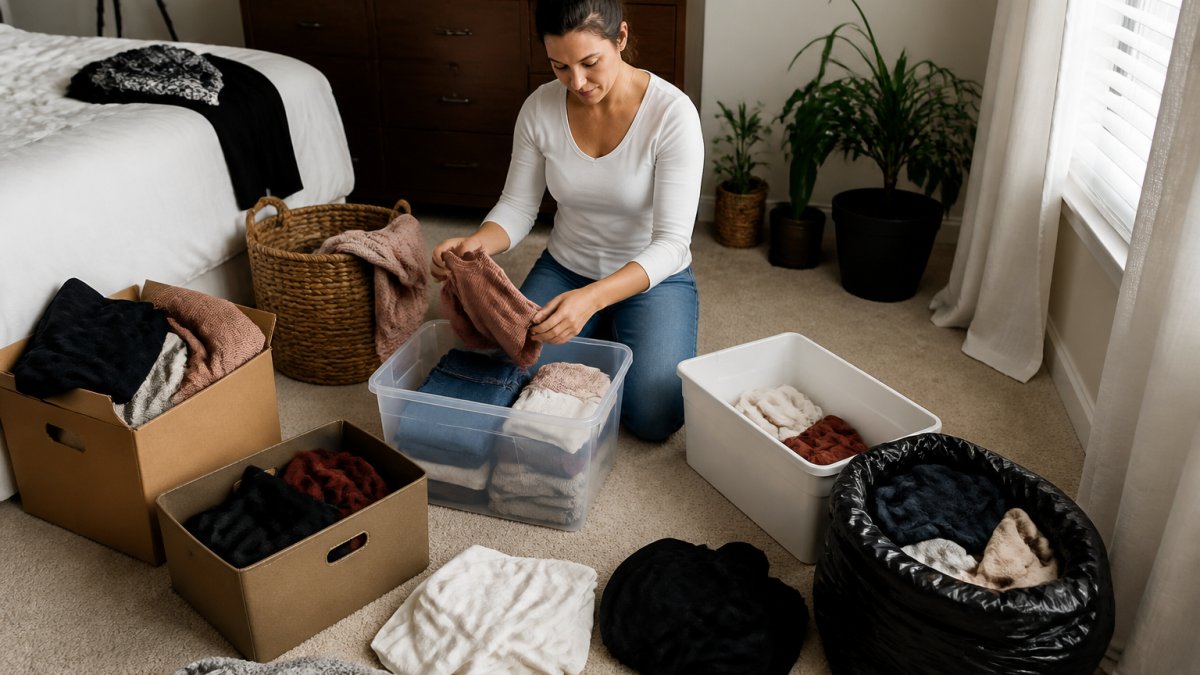
Start with a single room. Set a timer for 2-3 hours.
Keep pile: Items you use regularly or genuinely love.
Donate pile: Items in good condition you no longer use.
Discard pile: Broken items, worn clothing, expired products, and anything unusable.
Working room by room creates natural stopping points and builds momentum for the next room.
Decide What to Get Rid of Before Moving
The hardest part of decluttering before moving is deciding what to keep.
Ask yourself these questions for each item:
Do I use this? If you haven't used something in a year, you probably won't miss it. Unworn clothes, dusty gadgets, and abandoned hobby supplies are prime candidates.
Does this fit my new space? Large furniture that overwhelmed your old place won't work in a smaller home.
Is this broken or worn? Broken items cost money to move and take up space; worn-out furniture and clothing belong in the discard pile.
Do I have duplicates? Most homes have multiple versions of the same item, you probably don't need three coffee makers or five sets of sheets. Keep the best version and remove the rest.
Would I buy this again today? This simple test cuts through emotional attachment. If you wouldn't purchase it now, it's not worth moving.
How to Decide What to Keep When Moving
Keeping what matters requires honest evaluation: items you move should serve a purpose or bring genuine joy.
Focus on keeping things that fit these categories:
Daily-use items: Furniture you sit on, dishes you eat from, clothes you wear regularly, these earn their space.
Functional tools: Kitchen equipment that works well, cleaning supplies, basic tools.
Items with real value: Jewelry, electronics, collectibles, or furniture pieces worth money. These justify the moving cost.
Sentimental pieces: A few meaningful items from loved ones or important life events.
Items that spark joy: Objects you genuinely love looking at or using.
Be selective.
Handle Donation, Resale, and Disposal of Unwanted Items
Once you've sorted, plan how to get items out: every Donate, Sell, and Discard item should leave your home before moving day, not get packed by accident.
Donations: confirm before you load
- Call ahead to confirm what a charity accepts. Common exclusions include mattresses, box springs, large appliances, damaged furniture, and anything with stains or tears. Some organizations accept these but only at specific drop-off locations.
- Ask about pickup minimums and scheduling windows. Many national charities schedule pickups one to three weeks out, and some require a minimum number of items or a minimum value. Book pickup as soon as your donation pile is ready.
- Get a receipt. For tax purposes, itemize high-value donations and photograph items before they leave. Keep the receipt with your moving paperwork.
Resale: list early, price to move
- List high-value items (furniture, electronics, tools, collectibles) at least two weeks before your move. Most marketplace sales take 7-14 days from listing to pickup.
- Price using completed listings for comparable items, not asking prices. Price at or slightly below the midpoint to sell quickly.
- Set a deadline: if an item hasn't sold within 10-14 days, relist it lower or move it to Donate. Do not let unsold items become moving-day cargo.
Recycling: know what your center takes
- Electronics, metals, cardboard, and certain plastics are accepted at many municipal recycling centers, but accepted materials vary widely. Check your local center's list before loading the car.
- Retailers often take back specific items, batteries, light bulbs, and some electronics, at no cost. Check store policies before making a special trip to a recycling center.
- Break down cardboard boxes and flatten them; most centers require it and it saves space in your vehicle.
Hazardous materials: schedule, don't improvise
- Paint, chemicals, batteries, propane tanks, and old medications need special handling (the EPA). Contact your local waste management authority for household hazardous waste drop-off locations, hours, and any appointment requirements.
- Many communities host periodic collection events rather than year-round drop-off. Check the schedule early in your timeline so you don't miss the window.
- Never pour chemicals down drains or place them in curbside trash; this is often prohibited and can contaminate water systems (the EPA).
Bulky items: book removal before moving week
- Old furniture, appliances, and large items that don't sell or donate may require professional removal. Schedule this for the end of your decluttering timeline, after the final sweep but before packing.
- Confirm what the removal service accepts and whether there are additional fees for items like mattresses, appliances with refrigerants, or tires.
Build pickups and drop-offs into your moving decluttering timeline so nothing gets left behind or accidentally moved.
Schedule Your Professional Junk Removal Service
For large quantities or bulky furniture you can't move yourself, professional junk removal saves time and stress. Request a free estimate for professional junk removal services to understand your options and pricing.
Professional removal handles:
- Large furniture pieces
- Broken appliances
- Basement and attic cleanouts
When you explore full-service junk removal options, look for services that prioritize eco-friendly disposal, donating reusable items and recycling materials instead of sending everything to the landfill.
HaulerBoys Junk Removal offers same-day service with free onsite estimates. We handle the heavy lifting so you can focus on packing, and our team sorts items for donation and recycling, reducing waste.
Transparent pricing matters. Get quotes in writing before scheduling so you don't face surprise charges on moving day.
Frequently Asked Questions
How far in advance should I start decluttering before moving?
Start decluttering 6-8 weeks before your move date. This timeline gives you enough time to sort belongings without rushing, arrange donations and sales, and avoid last-minute stress. If you're moving sooner, begin immediately and focus on one room per week. Starting early also lets you measure how much junk removal you'll actually need, which helps with planning and budgeting.
What should I do with items I don't want to take to my new home?
Separate unwanted items into four categories: donate (clothing, furniture, household goods in good condition), sell (valuable items, electronics, antiques), recycle (paper, cardboard, metals, plastics), and discard (broken items, hazardous materials). Donate to local charities or shelters, list items for sale online or at yard sales, take recyclables to your municipal recycling center, and arrange professional junk removal for items that don't fit the other categories. This approach reduces landfill waste and can offset moving costs.
How do I decide what to keep when decluttering before a move?
For sentimental items, keep only those that genuinely bring joy or serve a purpose. Ask yourself: Have I used this in the past year? Does it fit my new space? Would I buy it again today? Be honest about duplicates (mystery cords, extra kitchen tools, unused office supplies) and unfinished projects. This discipline reduces what you pack, lowering moving costs and simplifying unpacking.
What are the biggest decluttering mistakes when preparing to move?
Common mistakes include starting too late (creating last-minute stress), keeping items out of guilt rather than actual need, not sorting into clear categories (keep, donate, sell, recycle, discard), and overlooking forgotten areas like bathroom storage, closet shelves, and garage corners. Many people also underestimate how long decluttering takes and fail to arrange disposal logistics early. Avoid these by starting early, following a room-by-room checklist, making quick decisions, and booking professional junk removal in advance if you have large items or a full basement.
Decluttering before moving transforms a stressful process into a manageable one. Start early, work room by room, and make honest decisions about what deserves space in your new home. When you're ready to remove large quantities of unwanted items, request professional junk removal assistance to handle the heavy work. HaulerBoys Junk Removal provides same-day pickups, eco-friendly disposal, and transparent pricing so your move goes smoothly and your new space starts fresh.
