

Junk Removal Pricing by Volume: A Complete Guide
Quick Summary
Junk removal pricing by volume sets your cost by how much of the truck your items fill, not by hours worked or weight hauled. Providers price in tiers such as quarter, half, three-quarter, and full loads. Converting every quote to cubic yards makes them easy to compare.
- Convert every quote to cubic yards, since 1 cubic yard equals 27 cubic feet.
- Estimate room by room, add a 10-15% buffer, then divide total cubic feet by 27.
- Ask each provider for its truck's cubic-yard capacity before comparing full-load prices.
- Confirm access, disposal, and surcharges are included, because a quote may rise on arrival.
- Compare price per cubic yard, not just the headline total.
Table of Contents
- How Junk Removal Pricing by Volume Works
- Converting Cubic Feet, Cubic Yards, and Truck Fractions
- How to Estimate Junk Removal Volume Before You Call
- Junk Removal Cost by Load Size: Quarter, Half, Three-Quarter, and Full Truckloads
- Factors That Change the Final Price
- Building a Junk Removal Pricing Sheet and Cost Calculator
- How to Compare Junk Removal Quotes Fairly
- Booking Your Volume-Based Quote with HaulerBoys
- Frequently Asked Questions
How Junk Removal Pricing by Volume Works
The core idea is straightforward: a crew fills a truck, and the price reflects what fraction of that truck your load uses.
This model has real advantages. You pay for the space you use, not for an arbitrary hourly rate that can climb if the job runs long.
A common mistake is assuming volume pricing always means the cheapest option. It doesn't.
Converting Cubic Feet, Cubic Yards, and Truck Fractions
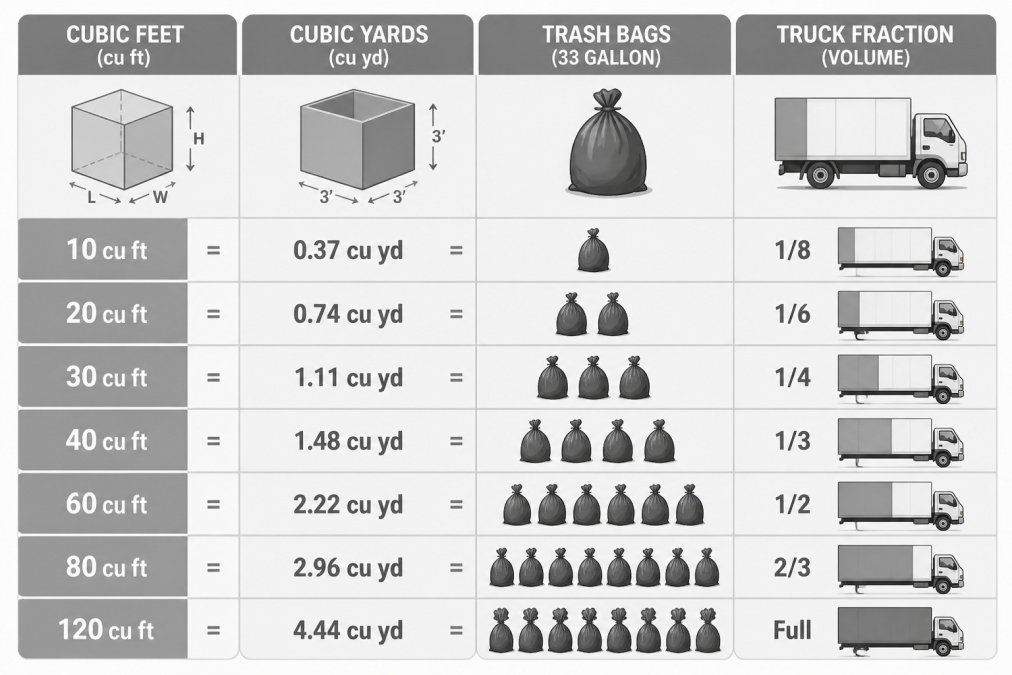
Different companies describe volume in different units, which makes comparing quotes difficult. Some quote cubic feet, some quote cubic yards, and some simply use truck fractions like "half load." The fix is to convert every quote to one common unit, cubic yards, before you compare. This section gives you the conversion math, a reference table, and worked examples so a "quarter load" from one provider and a "200 cubic feet" quote from another can be lined up side by side.
The only conversion factors you need
- 1 cubic yard = 27 cubic feet (3 ft × 3 ft × 3 ft)
- 1 cubic foot = 0.037 cubic yards (divide cubic feet by 27)
- 1 cubic yard ≈ 202 gallons of loose volume, useful when a quote is described in trash bags
- 1 standard curbside trash bag ≈ 1.5 to 2 cubic feet when packed, so roughly 13 to 18 bags fill one cubic yard
Reference table: truck fractions to cubic yards and cubic feet
Truck bodies vary by manufacturer and by provider, so treat these as typical ranges, not guarantees. Always ask the provider for the cubic-yard capacity of the truck they will send.
| Load description | Share of truck | Typical cubic yards | Typical cubic feet |
|---|---|---|---|
| Minimum / single item | 1/8 or less | 1-2 cu yd | 27-54 cu ft |
| Quarter load | 25% | 3-4 cu yd | 81-108 cu ft |
| Half load | 50% | 6-8 cu yd | 162-216 cu ft |
| Three-quarter load | 75% | 9-12 cu yd | 243-324 cu ft |
| Full load | 100% | 12-16 cu yd | 324-432 cu ft |
A common industry pattern is a truck body in the 12- to 16-cubic-yard range for full-service residential junk removal, with some providers running larger 15- to 20-cubic-yard bodies. That spread is exactly why a "full truck" from one company may not equal a "full truck" from another.
Worked example 1: comparing a fraction quote to a cubic-foot quote
Provider A quotes a half load at a flat tier price. Provider B quotes 180 cubic feet at a per-cubic-foot rate. To compare:
- Convert Provider B to cubic yards: 180 ÷ 27 = 6.67 cubic yards.
- Ask Provider A for the cubic-yard capacity of its truck. If it is 14 cubic yards, a half load is 7 cubic yards.
- The two quotes cover nearly the same volume (6.67 vs. 7 cu yd), so you can now compare total price and what each quote includes.
Worked example 2: converting a bag count
You have about 40 contractor bags of household clutter. At roughly 1.5 cubic feet per bag, that is 60 cubic feet. Divide by 27: about 2.2 cubic yards, a small load, likely near a provider's minimum charge rather than a half load. Knowing this stops you from accepting a half-load quote for a job that is closer to a minimum.
Worked example 3: price per cubic yard
If a quarter-load quote is $150 and the provider's truck holds 12 cubic yards, the quarter load is 3 cubic yards, so the effective rate is $50 per cubic yard. Run the same math on every quote and the headline numbers stop being apples-to-oranges.
How to Estimate Junk Removal Volume Before You Call
You can get a usable volume estimate before you pick up the phone, and doing so protects you from accepting a tier that is larger than your load. The method below is room-by-room, uses item-level cubic-foot reference points, and ends with a cubic-yard number you can hand to any provider. Round up at the end, loading inefficiencies (gaps between items, awkward shapes, disassembly) are real, and a 10-15% buffer is a common practice.
Step 1: Walk the space and list items by room
Go room by room with a notepad or your phone. For each room, list the large items first (furniture, appliances, mattresses) and then estimate bags and boxes as a group. Do not try to count every small item, group them.
Step 2: Use item-level volume reference points
These are typical loose-volume estimates for common household items. Actual volume depends on disassembly and how tightly items stack.
| Item | Approx. volume |
|---|---|
| Mattress (queen) | 40-50 cu ft |
| Sofa (3-seat) | 40-60 cu ft |
| Recliner or armchair | 20-30 cu ft |
| Dresser | 20-30 cu ft |
| Refrigerator | 40-50 cu ft |
| Washing machine or dryer | 25-30 cu ft |
| Dining table + 4 chairs | 40-50 cu ft |
| Desk | 20-25 cu ft |
| Treadmill | 30-40 cu ft |
| Box spring (queen) | 20-25 cu ft |
| Contractor bag (packed) | 1.5-2 cu ft |
| Standard moving box | 1.5-3 cu ft |
Step 3: Add up each room and convert to cubic yards
Total the cubic feet for the whole job, add a 10-15% buffer, then divide by 27 to get cubic yards. Compare that number to the truck-fraction table in the previous section to see which tier you likely fall into.
Worked example, garage cleanout:
- Old sofa: 50 cu ft
- Two shelving units: 30 cu ft
- 25 contractor bags: 40 cu ft
- Miscellaneous boxes: 30 cu ft
Worked example, one-bedroom apartment:
- Queen mattress + box spring: 70 cu ft
- Dresser: 25 cu ft
- Sofa: 50 cu ft
- Desk and chair: 30 cu ft
Step 4: Photograph and note access
Take photos from several angles, including the room layout, doorways, stairs, and where the truck can park. Photos help an estimator judge both volume and access, and access affects labor even when volume is unchanged. Note any items that need disassembly, any heavy items (a piano, a safe, a cast-iron tub), and anything regulated, paint, tires, electronics, mattresses, because those can carry separate fees regardless of volume.
Step 5: Confirm with an onsite or photo-based estimate
Your self-estimate is a starting point, not a quote. A provider that offers a free onsite estimate can confirm the number in person; a photo-based estimate is a reasonable alternative when access is simple. HaulerBoys Junk Removal offers free onsite estimates within 24 hours, so you can confirm the tier before committing.
Junk Removal Cost by Load Size: Quarter, Half, Three-Quarter, and Full Truckloads
Pricing by load size is easiest to understand as a set of tiers. Because pricing depends on quantity, dates, and delivery details, the right way to know your number is to request a quote from HaulerBoys Junk Removal's work request form or review load sizes on our demolition service page.
Load size is only one part of the figure. The same load can cost differently depending on where it sits, how far the crew must carry items, and what needs special disposal. Check our service areas to confirm that your county is covered before you compare numbers.
Single-Item and Small Load Pricing
Single items such as a mattress, a refrigerator, or a treadmill are often priced individually because they occupy a meaningful slice of the truck on their own. Small loads, such as a few bags and boxes, usually fall into the quarter-load tier. Ask whether a minimum charge applies, since many providers set one for very small jobs.
Factors That Change the Final Price
Several variables move a quote up or down, even for the same volume:
- Access: stairs, long carries, and tight driveways slow the crew
- Item type: heavy or hazardous materials can carry surcharges
- Disposal: landfill and recycling fees vary by material
- Timing: same-day or weekend requests may cost more than standard scheduling
Watch out: a quote that omits disposal and access details may rise once the crew arrives. Ask whether the price is all-inclusive.
Building a Junk Removal Pricing Sheet and Cost Calculator
A pricing sheet keeps your comparisons honest. Create a simple spreadsheet with columns for company name, load size quoted, cubic yards equivalent, total price, and what the price includes.
To build a basic cost calculator, divide each quote by its cubic-yard equivalent to get a price per cubic yard. Compare those figures across providers. A lower total price can still be the more expensive option if its load is much smaller.
How to Compare Junk Removal Quotes Fairly
Start by confirming that each quote covers the same scope: the same items, the same access conditions, and the same disposal method. Then check for hidden costs, such as fees for stairs, heavy items, or recycling.
Compare the price per cubic yard, not just the headline number. Finally, consider reliability: timely arrival, clear communication, and a satisfaction guarantee matter as much as the figure itself.
Booking Your Volume-Based Quote with HaulerBoys
Ready to get a number? Submit your load details through the work request form or start from our homepage to request a volume-based quote. Our team will confirm your load size, provide upfront pricing, and handle donations and recycling wherever possible. If you need removal quickly, see how to get same day junk removal service without surprises once you've picked your load size.
Get started with HaulerBoys Junk Removal today and clear your space with confidence.
Frequently Asked Questions
How does junk removal pricing by volume work?
Volume-based junk removal pricing charges according to how much space your items occupy in the truck, usually measured in cubic yards or as a fraction of a full truckload. A provider estimates the volume of your items, either on site or from photos, then assigns a load tier. Pricing depends on quantity, dates, and delivery conditions, so the most accurate way to get a current figure is a free estimate. Visit the HaulerBoys website to request one.
How much does junk removal cost for a quarter truckload?
A quarter truckload is the smallest common volume tier and typically covers a few items such as a couch, a mattress, or several boxes. The exact price depends on the items, their location, and any disposal requirements. Because rates vary by job, HaulerBoys provides upfront pricing based on a free estimate rather than a published flat rate. Request an estimate to see the figure for your specific load.
Is junk removal priced by volume, weight, or both?
Most residential junk removal is priced primarily by volume, since truck space is the main constraint. Weight can matter for dense materials such as concrete, dirt, roofing shingles, or appliances with heavy components, and some providers apply surcharges for these. Ask whether a quote includes any weight-based or special disposal fees before you book, so there are no surprises on the final invoice.
How can I estimate the volume of junk I need removed?
Start by grouping items by type and measuring the largest pieces, then estimate how much of a standard truck bed or cargo area they would fill. A full truckload is commonly used as a reference point, so you can describe your job as a quarter, half, or three-quarter load. Photos taken from several angles help a provider give a more accurate estimate. Clear, well-lit photos of each room speed up the quote process.
